The Financial Exposure of Manual Insurance and Driver Verification
The measurable financial risk of manual insurance and driver verification
Insurance and driver’s license verification is often treated as a procedural safeguard. But when evaluated quantitatively, manual verification represents a measurable financial exposure for dealerships.
The issue is not whether verification occurs, it’s whether it is accurate, real-time, and consistently documented.
When transportation programs expand through loaners, paid rentals, and on-demand options, even small verification gaps scale into meaningful risk.
Let’s look at the numbers.
- The Statistical Exposure Problem
National industry data indicates that approximately 8–14 percent of drivers carry lapsed, canceled, or insufficient insurance coverage at any given time. Additionally, millions of drivers operate with expired, suspended, or restricted licenses.
In a dealership processing:
- 20 transportation-related transactions per day
- 250 operating days per year
That equals 5,000 annual driver interactions involving dealership-controlled vehicles.
At a conservative 10 percent risk exposure rate:
- 500 transactions per year may involve questionable coverage or license status
Even if only a fraction of those cases result in incidents, the exposure is not theoretical, it is statistical.
- Incident Cost Modeling
Consider a moderate accident involving a loaner vehicle with insufficient customer coverage.
Typical exposure may include:
- Property damage
- Bodily injury liability
- Legal defense costs
- Administrative overhead
Even minor uncovered incidents can reach $25,000 to $75,000 in total cost. Severe cases can exceed six figures.
If automated verification prevents even one uncovered incident over multiple years, the financial protection alone may justify implementation.
- Labor Cost of Manual Verification
Manual verification also carries measurable operational cost.
Studies of service lane workflows show advisors spend 3 to 7 minutes per transportation-related transaction reviewing documentation, logging data, and handling exceptions.
Using a mid-range example:
- 5 minutes per transaction
- 20 transactions per day
- 100 minutes daily (1.7 hours)
Across 250 days:
- 425 advisor hours annually
At a fully burdened labor cost of $35 per hour:
- Approximately $14,875 annually in administrative labor
This does not include the opportunity cost of reduced upsell focus or workflow delays.
- Audit and Documentation Risk
Manual systems rely on paper copies, scanned documents, or manual logs. These methods introduce:
- Inconsistent documentation
- Missing time stamps
- Difficulty reconstructing records during disputes
In an audit or claim scenario, inability to prove coverage verification at the time of vehicle release weakens the dealership’s position.
Automated verification systems create time-stamped confirmation logs, reducing evidentiary risk.
- Scaling Risk with Transportation Growth
Transportation complexity is increasing. Many dealerships now operate:
- Loaner fleets
- Paid rental programs
- Shuttle services
- Ride alternatives
Each program increases the number of verification events. As volume grows, so does cumulative exposure.
Manual processes do not scale cleanly. The more transactions performed, the greater the probability of oversight.
- The Automation Impact
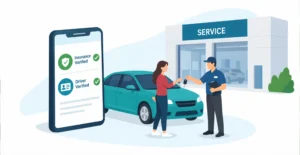
Connexion Mobility integrates with Modives through CheckMy Driver to provide real-time insurance and driver verification.
Instead of relying on visual inspection:
- Insurance policies are confirmed active
- Coverage adequacy is validated
- Driver licenses are verified for validity
This shifts verification from document review to data confirmation.
The impact is twofold:
- Reduced liability exposure
- Reduced administrative labor
When measured against potential incident costs, labor savings, and compliance protection, automated verification becomes a risk management investment rather than a process upgrade.
The Financial Perspective
Manual insurance and driver verification carry three measurable costs:
- Statistical incident exposure
- Administrative labor burden
- Documentation and audit vulnerability
As transportation programs scale, those risks compound.
From a financial standpoint, structured, real-time verification introduces control, consistency, and documentation, protecting both operational flow and long-term margin stability.
In a high-volume service environment, verification is no longer just administrative diligence. It is quantifiable risk management.