Executive Brief
Most Dealer Principals focus on the levers that visibly drive performance: sales volume, gross margin, technician productivity, and customer retention. Lot management rarely enters that conversation.
It should.
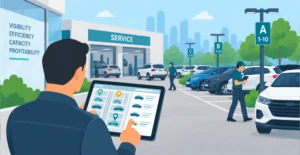
The service lot is not just a parking area. It is a moving part of your fixed operations engine. When vehicle flow lacks visibility, the impact is not operational inconvenience, it is financial drag.
The Financial Reality
Across service departments, technicians and porters commonly spend 5 to 15 minutes per repair order locating or repositioning vehicles when lot tracking is manual. In a mid-volume store processing 50–60 repair orders daily, that can translate into thousands of lost labor hours annually.
Recovered labor capacity alone can represent five-figure to six-figure value per year, without hiring additional staff.
Beyond labor, lot inefficiency affects:
- Daily repair order throughput
- Customer pickup times
- Advisor productivity
- Cycle time consistency
Even a modest 5 percent improvement in service throughput can produce meaningful incremental revenue in a high-volume service department.
Capacity Without Expansion
When service performance plateaus, the typical response is to consider:
- Additional staffing
- Expanded parking
- Physical facility growth
Before committing to new fixed costs, it is worth asking:
Are we fully utilizing the capacity we already have?
Improved lot visibility often unlocks latent throughput without expanding payroll or square footage. For Dealer Principals, this represents scalable growth rather than cost expansion.
Customer Experience and Retention
Service retention is one of the most powerful drivers of long-term dealership profitability. Operational friction, including delays during pickup or difficulty locating vehicles, directly impacts satisfaction.
Retention improvements of even a few percentage points can translate into hundreds of thousands of dollars in preserved annual service revenue, depending on store size.
The lot experience is part of the customer experience.
Risk and Asset Protection
Dealership lots contain millions of dollars in combined inventory and customer vehicles. Lack of structured tracking increases exposure to:
- Misplacement incidents
- Documentation gaps
- Security risks
- Disputes during insurance or claim reviews
Improved visibility enhances accountability and reduces preventable exposure.