
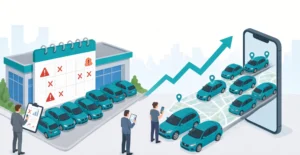
Why are more dealerships adding paid rentals to fixed operations
How paid rental is transforming dealership fixed operations
Why paid rental is becoming part of modern dealership service operations
For years, dealership transportation options revolved around loaner vehicles, shuttle services, or sending customers to an outside rental company. Those solutions still have their place, but many dealerships are discovering another option that offers more flexibility and better financial performance.
Paid rental programs are becoming an important part of modern fixed operations.
Rather than viewing rentals as an occasional accommodation, dealerships are integrating them into their daily service process. The result is a transportation option that benefits both customers and the dealership.
Service Departments Are Busier Than Ever
Today’s service departments are managing higher repair volumes, longer repair times for some vehicles, and customers who rely heavily on their transportation.
Not every customer qualifies for a complimentary loaner.
Not every repair justifies providing one.
Paid rental fills that gap.
Instead of saying no, advisors can offer a convenient transportation option that allows customers to stay mobile while their vehicle is being serviced.
Giving Customers More Choices
Every customer has different transportation needs.
Some prefer to wait.
Some arrange their own ride.
Others need another vehicle immediately.
Offering paid rental gives customers another option without forcing the dealership into providing free transportation every time.
Customers appreciate having a choice, especially when the rental process is quick and easy.
Paid Rental Supports Profitability
Transportation has traditionally been viewed as an expense.
Shuttle drivers, fuel, maintenance, and loaner depreciation all add up.
Paid rental changes that equation.
Instead of absorbing every transportation cost, dealerships create an additional revenue opportunity while making better use of their fleet.
When managed properly, rental income can help offset operating costs while improving overall service profitability.
Better Visibility Across the Fleet
One of the biggest challenges with dealership transportation is simply knowing where vehicles are.
Without a structured system, staff often spend valuable time asking questions like:
- Which vehicles are available?
- Who has this rental?
- When is it coming back?
- Has the agreement been completed?
A connected rental management system gives everyone the same information in real time.
That visibility improves scheduling and helps maximize fleet utilization.
Fewer Administrative Headaches
Managing rentals manually often creates unnecessary work.
Paper agreements.
Manual insurance verification.
Phone calls.
Spreadsheets.
Handwritten notes.
As rental volume increases, those processes become difficult to maintain.
Digital workflows simplify the entire process from reservation through vehicle return, reducing paperwork while helping employees work more efficiently.
A Better Experience for Advisors
Service advisors already manage multiple responsibilities throughout the day.
Adding transportation coordination shouldn’t create additional stress.
When paid rental is integrated into the service workflow, advisors can:
- Reserve vehicles faster
- Complete agreements digitally
- Verify drivers more efficiently
- Keep customers informed
- Spend more time serving customers
The process becomes consistent instead of improvised.
Customers Notice Simplicity
Most customers don’t think about dealership transportation until they need it.
What they remember is how easy or difficult the experience felt.
A streamlined paid rental program provides:
- Clear pricing
- Faster pickup
- Straightforward agreements
- Predictable expectations
That convenience helps reduce confusion and contributes to a better overall service experience.
Keeping Transportation Inside the Dealership
Sending customers to an outside rental agency often means giving up control of the experience.
Customers may have to travel elsewhere, complete additional paperwork, or wait for vehicle availability.
An in-house paid rental program keeps everything in one location.
The customer stays connected to your dealership from drop-off through vehicle pickup, creating a smoother experience while keeping transportation revenue in-house.
Technology Makes the Difference
A paid rental program is only as effective as the process behind it.
Connexion Mobility brings the entire workflow together in one platform, including:
- Driver verification
- Insurance validation
- Digital rental agreements
- Vehicle assignment
- Fleet tracking
- Rental reporting
Instead of managing transportation across multiple disconnected systems, dealerships gain a single streamlined process that is easier for employees and customers alike.
Looking Ahead
Customer expectations continue to evolve, and dealerships are looking for ways to improve efficiency while creating new revenue opportunities.
Paid rental helps accomplish both.
It gives customers greater flexibility, provides staff with better tools, and helps dealerships make better use of transportation assets they already own.
As more dealerships modernize their service operations, paid rental is becoming less of an exception and more of a standard offering.
Final Thought
Transportation is no longer just a courtesy.
It has become an important part of the overall service experience.
With the right technology, paid rental can help dealerships improve customer satisfaction, simplify daily operations, and create an additional source of revenue – all while keeping the entire experience under one roof.