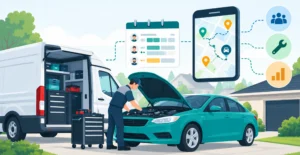
How mobile service is reshaping technician roles and staffing strategy
How mobile service is changing dealership technician staffing and retention
Mobile service is often discussed in terms of customer convenience and service growth, but one of its most significant impacts is happening behind the scenes. As dealerships struggle with technician shortages and rising labor costs, mobile service is quietly reshaping how service teams are staffed, scheduled, and retained.
From recruitment to daily workflow, mobile service introduces a different technician experience, and the data suggests that difference matters.
Technician shortages are driving operational change
The automotive industry continues to face a well-documented technician shortage. Industry workforce reports estimate that dealerships will need tens of thousands of additional technicians over the next decade to keep pace with vehicle parc growth and service demand. At the same time, technician turnover remains high, particularly among early- and mid-career technicians.
In this environment, efficiency alone is no longer enough. Dealerships must find ways to make technician roles more sustainable, predictable, and attractive.
Mobile service contributes to that shift.
Mobile service changes how technicians spend their time
Traditional in-store technician workflows involve frequent interruptions. Vehicles must be moved, bays cleared, and work paused to accommodate changing priorities. Mobile service operates differently.
Data from dealership mobile service programs shows that mobile technicians often achieve 10 to 20 percent higher wrench time compared to their in-store counterparts when routes are properly planned. Fewer interruptions and more consistent work scopes allow technicians to focus on completing tasks rather than navigating the service drive.
This efficiency benefits the dealership, but it also improves technician satisfaction. Predictable workdays reduce frustration and burnout, two common contributors to turnover.
Scheduling flexibility improves retention
Work-life balance is an increasing priority across skilled trades, including automotive service. Mobile service introduces new scheduling models that appeal to technicians seeking flexibility.
Dealerships offering mobile service roles report improved retention among technicians who prefer daytime schedules, predictable routes, or reduced exposure to high-volume service lane pressure. In some cases, mobile service positions are used as long-term roles rather than rotational assignments.
Workforce studies show that employees with greater schedule predictability are 30 percent more likely to remain with an employer over a two-year period. Mobile service helps create that predictability in an industry known for long and irregular hours.
Mobile service supports smarter labor allocation
Mobile service also allows dealerships to better align technician skill levels with work types. Routine maintenance, recalls, and light repairs can be handled by mobile technicians, while complex diagnostics and high-skill repairs remain in the shop.
This segmentation improves overall labor utilization. High-skill technicians spend more time on work that matches their expertise, while mobile technicians handle repeatable, well-defined tasks efficiently.
Dealerships that adopt this model often report higher overall labor productivity without increasing headcount, as work is routed to the most appropriate environment.
Recruitment becomes more competitive
Mobile service also changes how dealerships present themselves to potential hires. Offering mobile service roles signals innovation and adaptability, traits that resonate with younger technicians entering the workforce.
Surveys of trade professionals show that over 40 percent of technicians value employers that invest in modern tools and flexible work models. Mobile service aligns with those expectations, helping dealerships differentiate themselves in a competitive labor market.
Why coordination matters
The workforce benefits of mobile service depend on execution. Poor routing, inconsistent scheduling, or lack of visibility can quickly undermine technician satisfaction. Mobile service must be coordinated alongside in-store operations to deliver predictable workloads.
Platforms like Connexion Mobility help dealerships manage mobile service as part of a unified service operation, ensuring technicians have clear schedules, realistic routes, and consistent expectations.
Mobile service as a workforce strategy
Mobile service is more than a customer-facing initiative. It is becoming a workforce strategy that helps dealerships address technician shortages, improve retention, and deploy labor more effectively.
As staffing challenges continue to shape fixed operations, dealerships that view mobile service through a workforce lens will be better positioned to build resilient, scalable service teams for the future.