The New Standard for Dealership Transportation Management
Dealership transportation is evolving, and manual processes can’t keep up
Article
Transportation inside dealerships used to be simple.
A test drive required a copied license.
A loaner required a signed agreement.
A toll notice required manual reconciliation.
Each function lived in its own silo.
Today, transportation looks very different.
Dealerships now manage a connected ecosystem of:
- High-volume test drives
- Service loaner fleets
- Paid rental programs
- On-demand mobility
- Toll activity across metro markets
- Insurance verification requirements
- Driver’s license compliance checks
The volume is higher. The liability is greater. Customer expectations are faster.
And manual systems are struggling to keep up.
Complexity Has Increased, But Processes Haven’t
Over the last decade, dealership transportation volume has grown significantly. More vehicles are in motion daily. More customers expect flexible mobility options.
But in many stores, the processes supporting transportation are still:
- Paper-based
- Spreadsheet-driven
- Department-specific
- Reactive
When complexity increases, but systems do not evolve, gaps appear.
Those gaps show up as:
- Documentation inconsistency
- Delayed toll billing
- Unverified insurance coverage
- Suspended license blind spots
- Lost administrative time
- Customer friction
Transportation risk does not appear as a single dramatic event. It appears as accumulated variability.
The Shift Toward Unified Management
Modern dealerships are moving toward centralized transportation oversight.
Why?
Because disconnected systems create hidden exposure.
When test drives, loaners, toll tracking, and verification are managed independently, leadership lacks visibility into:
- Who is driving what
- Whether credentials were verified
- Whether tolls were recovered
- How many active vehicles are out
- Where risk is accumulating
Visibility drives control. Control drives consistency.
What a Modern System Looks Like
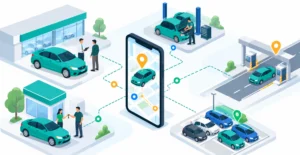
A modern dealership transportation system does not rely on isolated tools.
It integrates:
- Real-time driver’s license verification
- Insurance validation
- Test drive documentation
- Loaner and rental tracking
- Automated toll management
- Centralized reporting
This approach transforms transportation from a collection of tasks into a coordinated system.
Connexion Mobility provides that unified control layer.
Rather than replacing individual programs, Connexion connects them, embedding verification, tracking, and reporting into the workflow itself.
The result is:
- Reduced liability exposure
- Fewer administrative bottlenecks
- Improved charge recovery
- Stronger compliance documentation
- Real-time operational visibility
Transportation as a Strategic Asset
Dealership transportation programs are not just operational necessities. They are competitive differentiators.
A smooth test drive process improves conversion.
A well-managed loaner program protects retention.
Accurate toll billing preserves trust.
Real-time verification reduces risk.
When dealerships manage these functions under one structured platform, they gain more than efficiency.
They gain confidence.
The Next Phase of Dealership Operations
As vehicle values increase and regulatory expectations tighten, transportation risk becomes harder to ignore.
Manual systems were built for a lower-volume era.
Modern dealership operations require integrated oversight.
Connexion Mobility is built specifically for this evolution, providing dealerships with the tools to manage transportation comprehensively, rather than piecemeal.
Because transportation is no longer a background function.
It is a system.
And systems perform best when they are unified.