
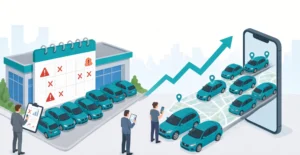
The hidden performance gaps inside dealership service loaner programs
Toll Management Solutions: How Dealerships Can Avoid Unnecessary Costs and Enhance Customer Satisfaction
Service loaner programs are often viewed as a customer satisfaction tool. When managed well, they help keep customers mobile and protect service retention. When managed poorly, they quietly become one of the most expensive and risk-prone areas of fixed operations.
The challenge is that many dealerships do not fully measure how loaner fleets perform day to day. Without visibility, inefficiencies compound over time.
Loaner utilization is often lower than expected
Loaner vehicles represent a significant capital investment, yet utilization is frequently uneven. Fixed operations benchmarks show that many dealerships operate loaner fleets at just 60 to 70 percent utilization, even during high service volume periods.
Low utilization drives up cost per loaner day. Vehicles sit idle while depreciation, insurance, and carrying costs continue. At the same time, customers may still experience shortages during peak demand windows because vehicles are not allocated efficiently.
Without accurate tracking of availability, mileage, and assignment duration, it becomes difficult to right-size the fleet or redeploy vehicles where they are needed most.
Mileage and fuel variability increase operating costs
Loaner costs are not limited to acquisition and depreciation. Mileage accumulation and fuel usage have a direct impact on resale value and operating expense.
Industry data shows that loaner vehicles often accumulate 20 to 30 percent more mileage than anticipated annually, driven by extended assignments, untracked personal use, or inconsistent return enforcement. Fuel costs also rise when policies are unclear or unenforced.
These factors reduce remarketing value and increase accounting complexity, particularly when fuel reimbursement or internal chargebacks are handled manually.
Compliance gaps create unnecessary risk
Loaner programs also carry compliance and liability exposure. Incomplete documentation, expired licenses, or unclear assignment records increase risk during audits or incident reviews.
Operational audits consistently show that documentation gaps are most common in loaner programs managed through manual logs or disconnected systems. These gaps create challenges for insurance claims, OEM reporting, and internal accountability.
Clear policies are essential, but policies alone are not enough without systems that enforce and document them consistently.
Loaners affect advisor workflow more than expected
Service advisors often act as informal loaner managers. When systems are manual, advisors spend time checking availability, tracking returns, and resolving exceptions.
Time studies indicate advisors can spend five to eight minutes per repair order managing loaner-related tasks in high-volume stores. That time detracts from customer communication, upselling recommended services, and workflow management.
Improving loaner visibility and automation directly improves advisor productivity.
Data-driven loaner management changes outcomes
When loaner programs are measured and managed with data, performance improves quickly. Dealerships that introduce centralized loaner tracking and reporting often see:
- 10 to 20 percent reductions in loaner days per repair order
- Improved vehicle turnaround and higher utilization
- Lower administrative time spent on tracking and reconciliation
- More consistent customer experience
Better data also enables smarter decisions about when a loaner is truly necessary versus when alternative transportation options may be more efficient.
Loaner programs as part of a broader mobility strategy
Loaners should not operate in isolation. They work best as part of a broader mobility mix that includes shuttles and ride alternatives. When loaners are reserved for the right use cases, overall transportation costs decline without sacrificing convenience.
Platforms like Connexion Mobility support this approach by helping dealerships manage loaner fleets with visibility, controls, and reporting that align with fixed operations goals.
Turning loaners into a controlled asset
Service loaners are not inherently expensive or risky. They become that way when they lack structure, visibility, and accountability.
Dealerships that treat loaner fleets as operational assets rather than courtesy giveaways gain tighter cost control, stronger compliance, and a more consistent service experience. As service complexity increases, disciplined loaner management is no longer optional. It is a requirement for sustainable fixed operations performance.