
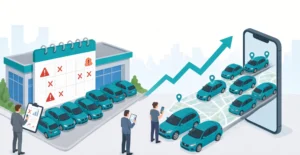
Loaners vs shuttles vs Ridehail: choosing the right mix for service transportation
Loaners vs Shuttles vs Ridehail: Choosing the Right Mix for Dealership Service Transportation
Dealership service departments rarely rely on a single transportation option. Loaners, shuttles, and Ridehail each play a role in keeping customers mobile while their vehicles are being serviced. The challenge is that many dealerships default to habit rather than strategy when deciding which option to use.
Understanding how these options compare side by side helps service leaders build a transportation mix that balances cost, efficiency, and customer experience.
Service loaners: high convenience, high carrying cost
Loaner vehicles offer the highest level of independence for customers, especially during multi-day or complex repairs. Customers can continue their routines without waiting or coordinating return trips, which makes loaners particularly valuable for longer service visits.
That convenience comes at a cost. Industry benchmarks show that loaner vehicles typically cost between $45 and $75 per day when depreciation, insurance, maintenance, and administrative overhead are included. Loaners also accumulate mileage quickly. Many dealerships report 20 to 30 percent higher annual mileage than planned, which reduces resale value at remarketing.
Loaners are most effective when reserved for longer repairs, warranty work, or customers with limited flexibility. When used for short or routine visits, they often represent the most expensive transportation choice.
Shuttles: predictable routes, efficiency challenges
Shuttles are designed for high-volume, short-distance transportation. When routes are predictable and demand is steady, shuttles can be a cost-effective option.
However, efficiency depends heavily on utilization. Data from fixed operations studies shows that average shuttle trips often carry fewer than two passengers, even when vehicles can transport four or more. When wages, fuel, insurance, and vehicle wear are included, average shuttle cost per trip commonly falls between $18 and $30.
Manual scheduling and routing contribute to underutilization and driver idle time. Shuttles perform best for grouped trips during peak hours but struggle to adapt to sudden changes in demand.
Ridehail: flexible capacity with variable cost
Ridehail introduces flexibility that fixed assets cannot match. Instead of carrying capacity year-round, dealerships pay for transportation only when it is needed.
Ridehail is particularly effective for short, one-way trips, overflow demand, or periods when shuttles and loaners are fully utilized. Studies show that blending Ridehail into the transportation mix can help dealerships reduce overall transportation cost volatility by 10 to 20 percent, especially during seasonal spikes.
Ridehail also reduces internal labor burden. Advisors spend less time coordinating rides, and transportation remains available even when demand exceeds expectations.
Matching the option to the service visit
The most effective transportation strategies do not choose one option over another. They match the option to the situation.
- Loaners work best for multi-day repairs, complex diagnostics, or customers who need full independence
- Shuttles are most efficient for predictable, short-distance routes during peak service windows
- Ridehail fills gaps, absorbs demand spikes, and handles low-occupancy trips more efficiently
When transportation is mismatched to the service visit, costs rise and efficiency drops.
Why orchestration matters
Managing these options independently creates blind spots. Without visibility into availability, utilization, and cost, decisions are often reactive.
Platforms like Connexion Mobility help dealerships orchestrate loaners, shuttles, and Ridehail within a single framework. This allows service teams to apply consistent rules, track performance, and adjust the transportation mix as demand changes.
Building a balanced transportation strategy
Transportation is no longer just a courtesy. It is a lever that affects service throughput, advisor productivity, customer satisfaction, and cost control.
Dealerships that take a data-driven approach to loaners, shuttles, and Ridehail gain flexibility without overspending. By understanding the strengths and tradeoffs of each option, service departments can deliver convenience where it matters most while keeping operations efficient and predictable.
In modern fixed operations, the right transportation strategy is not about choosing one option. It is about choosing the right option at the right time.