
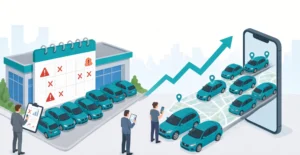
How shuttle management impacts dealership service throughput and profitability
Why shuttle management now shapes service efficiency and profitability
Shuttle services have long been a standard offering in dealership service departments. Traditionally viewed as customer convenience, shuttles are often managed manually and reactively. As service operations grow more complex and customer expectations continue to rise, shuttle management is increasingly influencing service throughput, advisor productivity, and fixed operations’ profitability.
What was once a courtesy is now an operational variable.
Inefficient shuttle management slows service throughput
Service throughput depends on how efficiently vehicles move through the service lane. Shuttle delays frequently disrupt that flow. When customers wait for a ride after check-in, repair approvals are delayed. When return shuttles are unclear or late, completed vehicles remain on site longer than necessary.
Industry data shows that transportation-related delays, including shuttle inefficiencies, can increase average repair order cycle time by 10 to 20 percent, particularly for maintenance and light repair visits. These delays compound during peak hours, reducing the total number of vehicles a service department can process in a day.
Manual shuttle scheduling often contributes to the problem. Without real time visibility into vehicle location, capacity, or estimated return times, advisors and drivers rely on phone calls or assumptions, creating bottlenecks across the service operation.
Advisor productivity suffers under manual shuttle coordination
Service advisors are responsible for driving revenue, yet shuttle coordination frequently pulls them away from customer-facing work. Studies across dealership service lanes indicate that advisors can spend 5 to 10 minutes per repair order handling shuttle-related tasks, such as scheduling rides, tracking driver status, or responding to customer questions.
With dozens of repair orders per day, this adds up to hours of lost productivity each week. That time comes at the expense of upselling recommended services, improving customer communication, and managing workflow effectively.
Centralized shuttle management reduces these interruptions by automating dispatching and providing real-time status updates. Advisors spend less time managing logistics and more time focused on service outcomes.
Shuttle costs are higher than many dealerships realize
Shuttle programs carry real costs that are often underestimated. When driver wages, fuel, insurance, vehicle wear, and idle time are fully accounted for, average shuttle rides typically cost between $18 and $30 per trip. Manual routing and scheduling result commonly in underutilized trips, with many shuttles operating at less than 50 percent of passenger capacity.
Without data, it is difficult to optimize routes, balance demand, or identify inefficiencies. Dealerships that implement structured shuttle management systems often see reductions of 10 to 25 percent in shuttle-related costs by improving utilization and reducing unnecessary trips.
Better shuttle experiences support customer retention
Transportation issues are a recurring theme in negative service reviews. Customers frequently cite waiting, lack of communication, or confusion around shuttle timing rather than dissatisfaction with the repair itself.
Service departments that offer reliable, predictable shuttle service experience measurable retention gains. Studies show that dealerships with structured transportation programs achieve repeat service visit rates 5 to 15 percent higher over a 12- to 24-month period. Convenience directly influences loyalty.
Shuttle management as a strategic tool
As service volumes increase and margins tighten, shuttle management can no longer be treated as an afterthought. Visibility, automation, and data-driven decision-making are becoming essential.
Solutions like Connexion Mobility support dealerships by transforming shuttle operations into a measurable, manageable part of the service workflow. When shuttle management is optimized, it improves throughput, reduces costs, and strengthens the overall service experience.